Reverse-charged VAT, import and foreign VAT
What Kasklaar does with an invoice without Dutch VAT: reverse charge from the EU or from outside the EU, and foreign VAT that goes into the cost or is set aside as a receivable
An invoice from a foreign supplier usually carries no Dutch VAT. Kasklaar then recognises one of three situations: the VAT is reverse-charged to you, the invoice is an import from outside the EU, or it carries foreign VAT you cannot deduct. Each gets its own booking.
Reverse-charged VAT
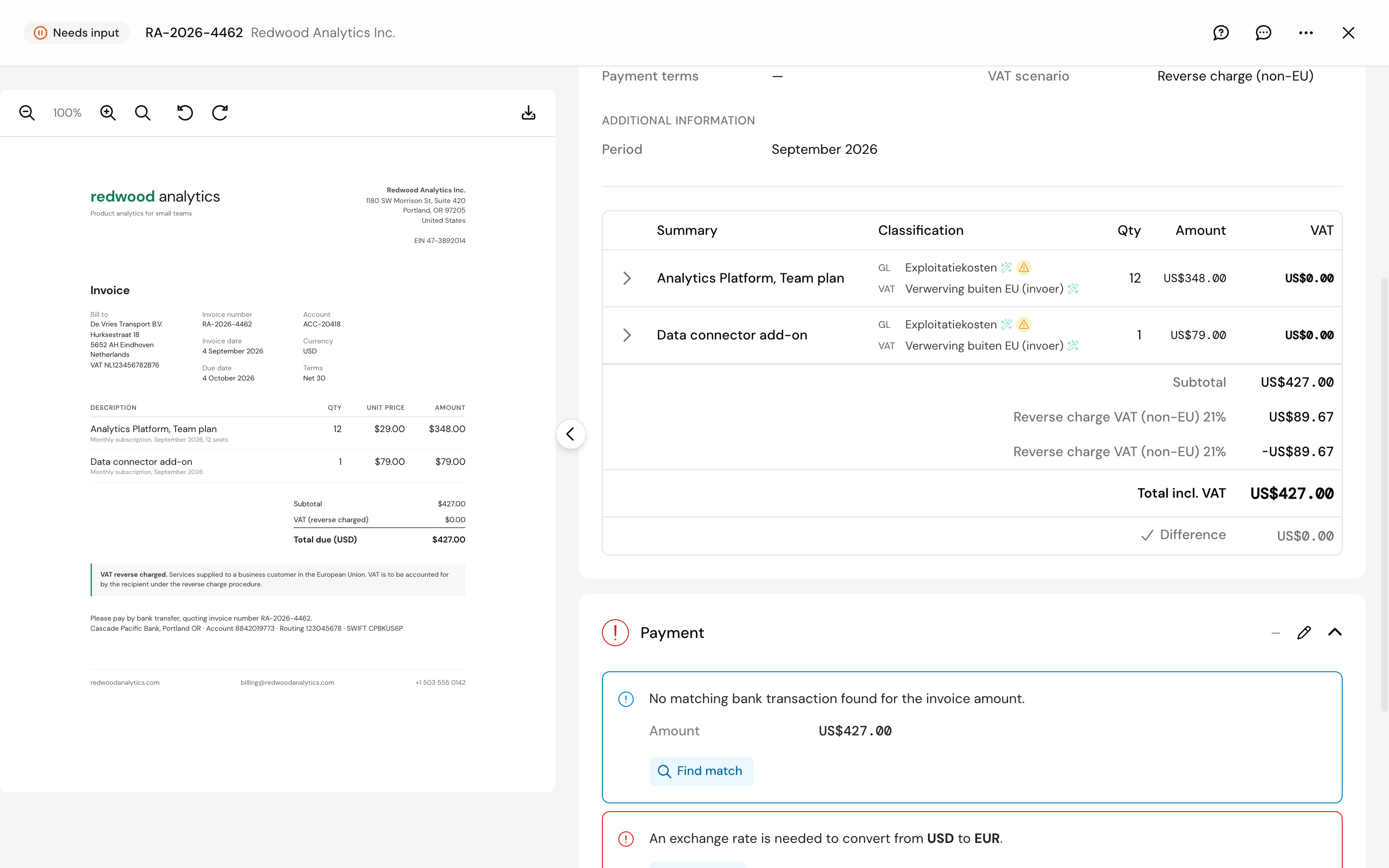
If the invoice says "VAT reverse charged" or refers to article 196, Kasklaar calculates the VAT you have to declare yourself: the amount at the Dutch rate, usually 21%. On the booking proposal you see that as two rows that cancel each other out, Reverse charge VAT (EU) 21% with a plus and a minus. On balance you pay nothing, but both amounts go into your return.
The line goes to Exact with the reverse charge code you configured under Administration details for that situation: EU supplier, non-EU supplier, or domestic (construction, waste). Exact handles the reverse charge through that code.
What is reverse-charged VAT again?
Normally the supplier charges VAT and pays it to the tax office. With reverse charge there is no VAT on the invoice; you declare it in your own return and deduct it in the same return. That happens with suppliers from another EU country, with imports from outside the EU, and in the Netherlands with subcontractors in construction.
Foreign VAT: into the cost or reclaimed
If you fill up in Germany or stay in a hotel in Belgium, the receipt carries German or Belgian VAT. That may not go into your Dutch return. Kasklaar then does the safe thing by default: the VAT goes into the cost, the amount including VAT becomes the cost amount and the line gets a 0% code. You see the notice Foreign VAT was grossed up with the gross-up amount. VAT from outside the EU always goes into the cost.
If you reclaim that VAT through the tax office, enable the country under Settings, Administration, Details, block VAT settings, EU VAT refund countries, with a ledger account where that VAT is set aside. Kasklaar then splits the line in two: the cost without VAT, and a line VAT receivable (DE) on that account. At the end of the year that account shows exactly what you can reclaim.
Not sure whether reclaiming is worth it? Ask your accountant. Leave the country off and the VAT goes into the cost and nothing goes wrong; you only miss the refund.
When Kasklaar asks you
- GL account for foreign VAT not configured: you enabled a country without an account for that VAT. Click Configure GL and pick an account; the invoice is then reprocessed immediately.
- No VAT code is configured for this scenario: your chart of accounts has no 0% code, or no reverse charge code for this situation. Set those under Administration details.
Frequently asked questions
The invoice is reverse-charged, but Kasklaar did not see it. At the top under VAT scenario choose Reverse charge with the right situation. Kasklaar then reassigns the codes.
There is VAT from more than one country on one invoice. Kasklaar then creates a line per country and says so in the notice VAT from more than one country. Each country gets its own treatment.
Why is the reverse-charged VAT also on a credit note? A credit note from a foreign supplier reverses the reverse charge: the same two rows, with the sign flipped.
Your agents got it wrong. Tell us, every time. Click the speech bubble at the top right of the invoice, Give feedback, and describe what went wrong; we look at it and use it to improve processing. Correct the invoice yourself as well, so it is right straight away.
See also
- How your agents determine the VAT scenario
- Administration details, for the reverse charge codes and EU VAT refund countries.
- Invoices in foreign currency